Kritika Thakur is a fourth-year law student at NLU Delhi.
At the fag end of the 20th century, when third wave feminism was just beginning to take form, Susan Okin was writing a deeply influential, gendered critique of Rawls’ conception of Justice in the book Justice, Gender and the Family. Okin engages in a feminist examination of how Rawls imagines the subject and agent of justice both, whom he conceptualises as a rational, mutually disinterested, free and equal person. The Rawlsian subject is atomized, with no ties to other people beyond social constructs that are hidden by the veil of ignorance. Okin attempts to complicate this understanding through the lens of family, by showing the ways in which inequality and inequity affects women within the family.
This is an important complication, for Rawls’ view without looking at the reality of gender and sexual division of labour within families had led to a glaring simplification in what was an attempt at a grand theory of justice. Okin’s critique begs the question “can justice be achieved without any concessions to gender”. She speaks to the unfair burden of carework that falls on the primary or default parent, who is most often the woman. Equally, however, Okin’s critique seems to think of women as a homogenous group, not recognizing the wildly varying degrees and types of injustice faced by women in social groups, family dynamics, sexualities and cultures that differ from the middle class cisgender woman in a heterosexual, nuclear family. The woman that Okin centers is too much of a minority to be applicable to a large swathe of women in the real world.
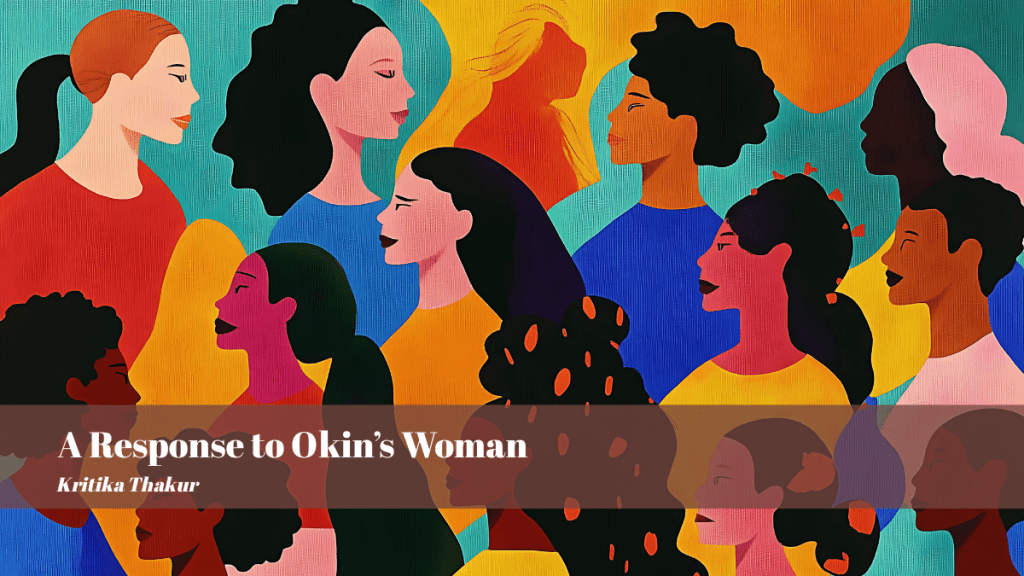
Despite being more comprehensive than Rawls, Okin still takes as her subject only a very specific type of subject: the Western, liberal, individualistic person. This paper explores the kind of subject a truly grand, universal theory of justice must examine, specifically through intersectional and relational lenses, to acknowledge the context many women are embedded in; because while the veil of ignorance in the original position is drawn over the context itself, the personality and character of people, and consequently, their conceptions of justice, are deeply affected by the contexts. This paper attempts to expand Okin’s subject of justice.
BACKGROUND
Within Rawls’ theory of justice, all the human beings within the original position, where the principles of justice upon which basic structures of society would be created are to be decided, are heads of families. This is one of their basic characteristics. Okin’s concern with this is that because everyone creating the theory of justice is the head of a family, there can be no meaningful interaction with any ideals of justice within the family.
John Rawls’s argument for considering all people within the original position as heads of families is that there must be a justification for those people to have some interest in intergenerational well being. Within this, he says that the way for people within said position to carry out this consideration is by imagining themselves as fathers, and measuring how much should be set aside for their sons based on how much they would expect from their own fathers. This ties into the idea of mutual disinterest, and ignores the fact that women tend to be aligned with the interests of the next generation without any real requirement of being a mother. Rawls doesn’t deal with this at all. Women don’t need to be heads of a family to wish for the well being of the next generation at large.
Rawls says that family, is the basic unit of society and that the differences in family situations do make a concerted difference in the lives of the men who come from them. Okin’s critique, however, has to do with the fact that Rawls assumes a monogamous family and never actually examines it from the lens of justice, and adult members of the family who are not the head of the family go unrepresented in the original position. Okin also criticizes the way in which children are treated within Rawls’ theory, since abusive households are unaccounted for in the paternalistic view he takes.
Okin also critiques the assumption that once the veil of ignorance is lifted, all people in the original position will participate in the paid labour market, as though there is no difference between the individuals who make up the household.
However, Okin doesn’t actually deal with the woman who does get paid because there is no choice, where her income is essential to the running of the household, but faces financial abuse despite it.
ANALYSIS
This blog argues that Okin’s critique of Rawls’ theory of justice can be extended to include women in cultures not her own, provided those who use it do not fall into the pitfalls already identified by a number of scholars in the field. The subject of the justice discourse could well be a woman, but this woman must be able to encompass the real women who suffer under the systems that make up the world, and cannot be an abstraction of a cisgender, white, middle class woman in a heterosexual relationship.
If one attempts to use Okin’s critique by creating such an abstraction and then tries to add the complexities and disadvantages of a real woman, one will have at the end of the process, a being comprised of such a number of contradictions that it will be patently useless to any ideations of justice. This is because one cannot externalise the context within which a human being develops, especially a woman, because of the peculiar way in which women are socialised from infancy.
Ignoring the multitude of interactions that create a woman to universalise her will lead to injustice, because these contexts are internal. What is required is a universal or grand theory of justice that does not hinge upon a specific type of woman to remain internally consistent because conflict between different identities often leads antagonism within the group.
It is important to realise that the experiences of tribal or dalit women living in villages are vastly different from the experiences of working, middle class women in urban India, which are once again equally different from the experiences of black women in America. The danger of universal theories of justice is precisely this- that it might subsume these differences which are precisely what make theories of justice so important.
Moreover, to examine Mari Matsuda’s critique, which hinges upon the methodology of abstraction, one can similarly extend her ideas to Susan Okin’s work. It is also important to realise that the woman that Susan Okin speaks of is normative and utopian. Ideas like equality and fairness don’t take into account the lived realities of women within the gendered social structures that prevail across the country. Race and class distort the image she creates of a woman who remains at home and carries out a disproportionate amount of housework and domestic chores, discouraged from seeking paid work. The danger one faces when dealing with Okin’s idealised and simplistically structured woman is that she, too, is an abstraction living a life that is almost like an ideal type, fulfilling a number of check boxes, inapplicable to the majority of women across the world.
CONCLUSION
This project argues that Susan Okin’s critique of Rawls can well be extended to marginalized communities within her culture as well as women of entirely different cultures provided that the extension doesn’t get caught up in typecasting women a certain way. Okin argues against the unfair division of labour, and if taken in that spirit, it applies across circumstances and situations. However if the reader fixates upon the letter of her work as it applies to stay at home mothers and wives, they will likely find that the critique does not apply to women steeped in other cultures. A good example of this is the fact that women from certain communities in India work overwhelmingly as domestic workers and other basic carework tasks where despite being paid, they are not paid highly, and they do not truly have any scope for a different field of work. This is not acknowledged in Okin’s work, but one can read the text in the spirit it was intended to be read in and see that Okin would likely have felt strongly on behalf of such women as well.



 The Law Blog
Leave a comment