Endalkachew Worku Lemecha is the Director of Legal Awareness, Education and Training at the FDRE Ministry of Justice, with over 14 years of experience in diverse legal areas. He holds an LLB from Haramaya University and an LLM from Addis Ababa University, and has authored numerous legal articles published across various online platforms and blogs.
Asset recovery has become a central tool for justice, governance, and financial integrity in modern legal systems. In Ethiopia, recovering assets derived from corruption, financial crimes, organized crime, and terrorism financing is essential for upholding the rule of law and safeguarding public resources. This blog examines Ethiopia’s legal framework for asset recovery, including the Asset Recovery Proclamation No. 1364/2025, and situates it within the country’s Anti-Money Laundering (AML) and Counter-Terrorism Financing (CFT) regime under Proclamation No. 780/2013 and its amendment Proclamation No 1387/2017. It evaluates operational challenges, procedural innovations, institutional coordination, and policy directions for strengthening asset recovery. Comparative insights from international standards (UNCAC, UNTOC, FATF) contextualize Ethiopia’s approach.
The 21st century has seen a shift in criminal activity from conventional property crimes to sophisticate financial and organized crimes. Corruption, money laundering, illicit trade, and terrorism financing increasingly undermine state capacity, economic stability, and national security. In Ethiopia, these crimes pose serious socio-economic risks, particularly in public procurement, financial systems, and governance structures.
Historically, Ethiopia focused primarily on punishing offenders, relying on conviction-based enforcement. However, evidence shows that this approach is insufficient in complex financial or organized criminal cases. Effective asset recovery, that is, the identification, seizure, and restitution of illicitly obtained property, has emerged as a crucial instrument to complement prosecution, prevent criminals from benefiting from illegal activity, and protect public and state resources.
The enactment of the Asset Recovery Proclamation No. 1364/2025 consolidates fragmented laws, introduces non-conviction-based confiscation, and aligns domestic law with international standards. Complementing this, the AML/CFT framework under Proclamation No. 780/2013 and its amendment Proclamation No 1387/2017 strengthens financial oversight, defines predicate offences, enhances investigative powers, and integrates beneficial ownership transparency, creating an ecosystem where asset recovery is both feasible and enforceable.
Concept and Objectives of Asset Recovery
Asset recovery can be conceptualized in three key stages:
| Stage | Description | Objective |
| Tracing | Identifying assets derived from criminal conduct, including digital, tangible, and intangible property | To locate illicit assets before they are transferred or concealed |
| Freezing/Seizing | Preventing disposal or transfer of identified assets | To preserve assets pending investigation or judicial decision |
| Confiscation & Return | Judicial transfer of assets to the state or victims | To remove economic incentives for crime and provide restitution |
The overarching goal is to ensure that “crime does not pay” while protecting public and private wealth. Effective asset recovery relies on integration with AML/CFT mechanisms to detect, trace, and seize illicit funds.
Integration with AML/CFT Reforms
Anti-Money Laundering and Counter-Terrorism Financing (Proclamation No. 1387/2017)
Proclamation No. 780/2013 and its amendment Proclamation No 1387/2017 modernized Ethiopia’s AML framework and strengthened its connection to asset recovery. Key reforms include:
- Expanded Definition of Predicate Offences – Twenty-one categories of crimes (including organized crime, corruption, terrorism, environmental crime, trafficking, tax evasion, and market manipulation) are recognized as generating illicit proceeds.
- Broad Definition of Property – Includes tangible, intangible, digital, and electronic assets, ensuring cryptocurrencies and virtual assets fall within recovery scope.
- Beneficial Ownership (BO) Transparency – Legal entities must maintain accurate BO information, submitted to a Central Beneficial Ownership Registry, enabling authorities to identify real owners.
- Cross-Border Controls – Mandatory declaration of cash and assets at borders, with customs empowered to seize undeclared funds and share information with the Financial Intelligence Service (FIS).
- Enhanced Investigative Powers – Introduction of special investigative techniques, including controlled deliveries, surveillance, and interception of communications, with judicial oversight.
- Parallel Investigations – Simultaneous investigations of predicate offences and money laundering ensure that the full chain of criminal activity is traced efficiently.
- Non-Conviction-Based Enforcement – Money laundering can be prosecuted independently of the predicate offence, supporting non-conviction-based confiscation under asset recovery laws.
Linkage to Asset Recovery
By expanding definitions, institutional authority, and investigative tools, Proclamation 1387/2017 directly supports effective asset recovery:
- Broad predicate offence coverage ensures most illicit proceeds are recoverable.
- BO transparency allows authorities to trace assets through legal structures.
- Digital asset coverage enables seizure of previously hard-to-recover assets.
- Cross-border controls and FIS powers facilitate timely freezing of illicit funds, preventing flight or dissipation.
Together with Proclamation No. 1364/2025, these measures create a cohesive legal ecosystem where AML/CFT enforcement underpins successful asset recovery.
International Legal Standards
UNCAC and UNTOC
The United Nations Convention Against Corruption (UNCAC) obligates states to recover stolen assets through international cooperation. The United Nations Convention against Transnational Organized Crime (UNTOC), on the other hand, focuses on proceeds of organized crime. Ethiopia’s asset recovery and AML/CFT framework now aligns closely with these standards, enabling mutual legal assistance, non-conviction-based confiscation, and institutional coordination for cross-border investigations.
FATF Standards
The Financial Action Task Force (FATF), an independent intergovernmental body established to set global standards for combating money laundering, terrorist financing, and proliferation financing, focuses on the following:
- Beneficial ownership transparency
- Reporting and monitoring of suspicious transactions
- Cross-border asset declaration and seizure
- Integration of digital financial platforms into regulatory oversight
Ethiopia’s reforms implement these standards domestically, improving compliance and international credibility.
Institutional Roles and Coordination
Following institutions play a crucial role in asset recovery in Ethiopia, with a frequent need for inter-institutional coordination.
- Prosecutorial Authorities – Lead investigations and initiate asset recovery proceedings.
- Judiciary – Ensures procedural compliance, safeguards rights, and adjudicates non-conviction confiscation cases.
- Financial Intelligence Service (FIS) – Monitors transactions, suspends suspicious activity, and supports tracing of illicit funds.
- Central Beneficial Ownership Registry – Maintains information critical for identifying real owners and tracing complex asset structures.
Institutional coordination remains essential, particularly in complex or transnational cases. Clear protocols and technology adoption are critical.
Integrated AML/CFT and Asset Recovery Framework
Figure 1 below visually illustrates how Ethiopia’s AML/CFT measures under Proclamation No. 780/2013 and its amendment Proclamation No 1387/2017 enable effective asset recovery under Proclamation 1364/2025.
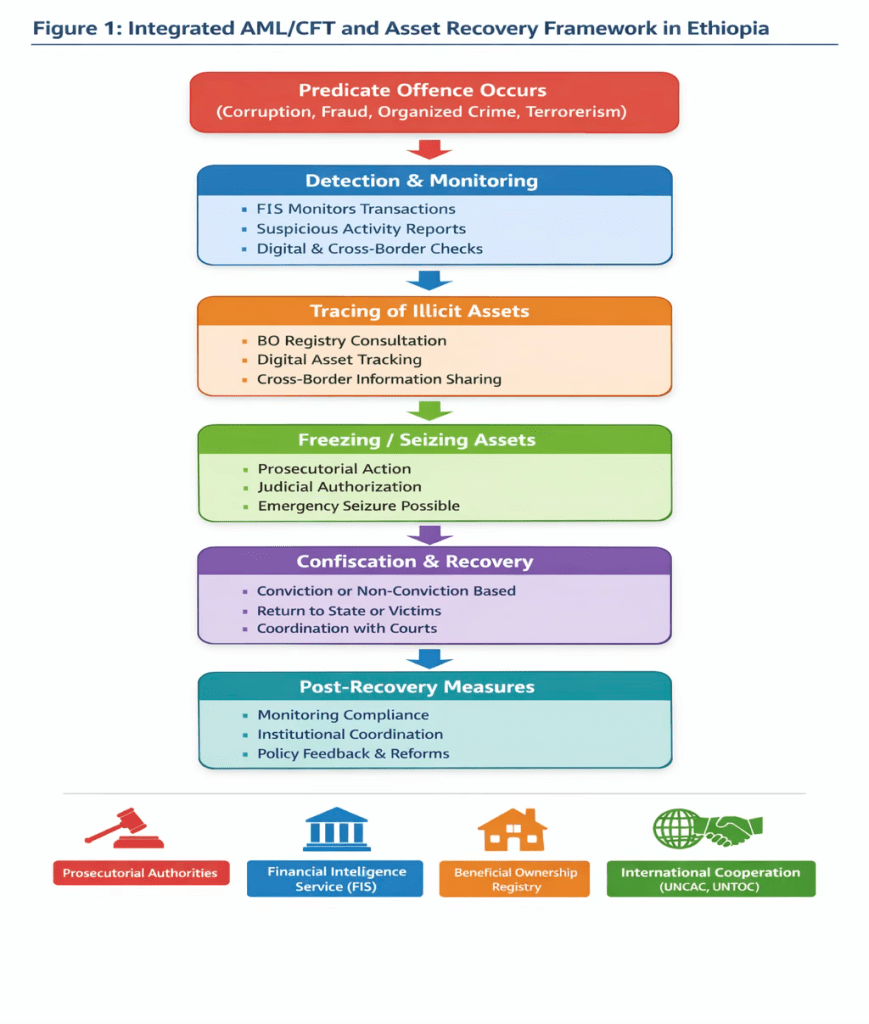
Some key points, however, are necessary to keep in mind regarding the roles of the various institutions involved. Prosecutorial Authorities lead investigations and initiate freezing/confiscation. Financial Intelligence Service (FIS) monitors, traces, and advises on suspicious assets. Central Beneficial Ownership Registry provides transparency on legal entities and owners. Judiciary ensures procedural fairness and authorizes non-conviction confiscation. International Cooperation (UNCAC, UNTOC) supports cross-border tracing, freezing, and return of assets.
Comparative Insights from Africa
In the Nigerian jurisdiction, EFCC and Asset Forfeiture Agency employ non-conviction-based confiscation, parallel AML and predicate offence investigations, and BO transparency frameworks. On the other hand, in South Africa, for example, civil forfeiture mechanisms under the Prevention of Organised Crime Act enable seizure of unexplained wealth, aligned with constitutional guarantees. Ethiopia’s reforms mirror these approaches, but further investment in institutional capacity, technology, and international cooperation is necessary to achieve operational efficiency.
The way ahead
The current system, however, presents plethora of challenges as well as opportunities in multiple ways. There remains a persisting capacity gap, highlighting the need for trained investigators, forensic accountants, and digital financial experts. The introduction of digital assets also mean that cryptocurrencies and virtual platforms require specialized tracking mechanisms. There are challenges in international cooperation as well, with mutual legal assistance procedures being often slow and bureaucratic. Finally, looking at institutional coordination, overlapping mandates demand clear protocols and data-sharing.
Policy Recommendations
- Expand specialized training in financial and digital forensics.
- Strengthen digital asset tracking and monitoring systems.
- Streamline mutual legal assistance procedures and enhance cross-border cooperation.
- Develop formal inter-agency coordination protocols for asset recovery and AML/CFT enforcement.
- Maintain judicial vigilance to balance enforcement powers with constitutional safeguards.
Conclusion
Ethiopia’s asset recovery system strengthened by Proclamation 1364/2025 and the AML/CFT reforms under Proclamation 1387/2017, provide a robust framework for combating financial crime, corruption, and organized criminal activity. The legal ecosystem integrates asset tracing, seizure, and confiscation with AML/CFT mechanisms, beneficial ownership transparency, and modern investigative powers. While institutional capacity and international cooperation remain challenges, these reforms place Ethiopia on a path toward effective, accountable, and internationally compliant asset recovery. Continued implementation, oversight, and reform will ensure recovered assets serve public interest, reinforce the rule of law, and deter financial crime.



 The Law Blog
Leave a comment