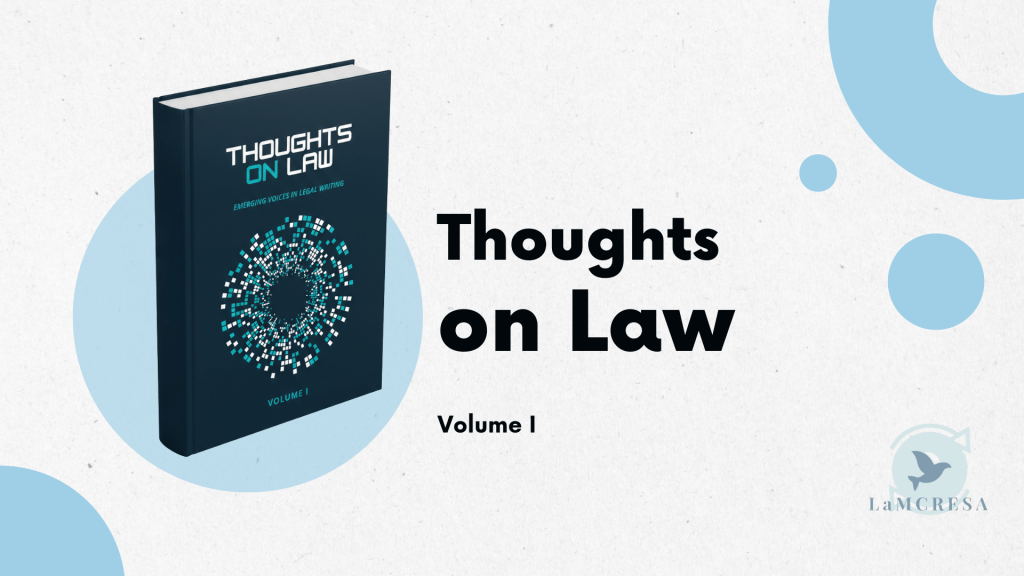
Law does not live only in courtrooms or statutes. It lives in conversations. It lives in questions. It lives in the everyday reflections of people trying to make sense of justice, power, rights, and responsibility in a changing world. Thoughts on Law emerged from that conviction. What began as digital essays published over time on The Law Blog has now been brought together in book form, not to impose thematic order, but to preserve a moment of civic engagement with law. The writings were curated largely chronologically, lightly revisited for clarity, and presented intentionally without any imposed thematic categorisation to invite openness and discovery. Yet when read together, something deeper becomes visible. A pattern of inquiry. A generational instinct. A shared willingness to question law at its edges.
Syed Suhaib and Neeva Ojha open the volume with a philosophical metaphor that is as ancient as it is unsettling: the Ship of Theseus. In examining deceptively similar trademarks through disputes such as Indigo’s “6E” litigation and comparative cases involving Adidas, they expose a core anxiety within intellectual property law. When does resemblance become misappropriation? When does incremental alteration transform identity? Their discussion of the rule of anti-dissection and the rule of dominant feature shows courts navigating conceptual thresholds rather than applying formulaic tests. Law here strangely reminds us of Prof. Hart, in how it turns interpretive, almost metaphysical, compelled to decide when continuity becomes difference at the penumbra.
That interpretive tension reappears in a contemporary digital register in the essay by Prathwiraj Kadam and Samikshya Rout on e-commerce liability. Their interrogation of whether platforms are intermediaries or participants challenges the comforting fiction of technological neutrality. By situating Indian jurisprudence between the European Union’s precautionary obligations, the United States’ innovation-focused immunity, and China’s supervisory model, they reveal a structural truth: platforms shape markets. They structure visibility, curate access, and monetise attention. Safe harbour doctrines, once justified by technical limitation, strain under the weight of algorithmic control. Law must decide whether classification suffices or whether responsibility should follow power. In doing so, the essay captures a shift from formal labels to functional accountability.
Questions of institutional responsiveness surface vividly in Tadgh Quill-Manley’s analysis of scramblers and electric scooters in Ireland. Through the lens of regulatory lag, Tadgh shows how legal systems often respond to crisis rather than anticipate it. Legislation and enforcement evolve incrementally, yet technological practices proliferate rapidly. Can law, by design deliberative and cautious, ever truly keep pace with innovation-driven risk?
The moral architecture of law is brought into sharp relief in Shivani Tripathi’s essay on famine and children’s right to food in Gaza. Grounded in the Convention on the Rights of the Child, the ICESCR, the Fourth Geneva Convention, and the Rome Statute, her argument reframes starvation not as unfortunate humanitarian fallout but as a juridically cognisable violation. The deliberate obstruction of food supplies becomes not merely political controversy but potential war crime. Here, law is reclaimed as a language of accountability. It is shown to carry not only regulatory force but moral urgency. In the face of catastrophe, legal norms become instruments through which the international community must articulate responsibility.
Historical perspective deepens this reflection in Quill-Manley’s exploration of railway litigation in the United Kingdom. Through cases such as Brogden v. Metropolitan Railway, Herrington, and Taff Vale, Tadgh demonstrates how industrial transformation forced doctrinal innovation. Railways disrupted economic and social life, compelling courts to refine principles of contract formation, exclusion clauses, negligence, labour rights, fiduciary responsibility, and constitutional doctrine. Railway disputes acted as doctrinal pressure points, exposing weaknesses in existing rules and prompting both judicial creativity and legislative reform. The parallel with today’s digital infrastructures is unmistakable. Yesterday’s railways and today’s platforms both serve as catalysts for legal transformation.
The theoretical foundations of justice are interrogated by Kritika Thakur in her response to Susan Okin’s feminist critique of Rawls. While acknowledging Okin’s exposure of gendered inequality within the family, Thakur presses further, questioning the abstraction of “woman” that remains centred within Okin’s framework. By invoking intersectional and relational lenses, she destabilises universalist models that fail to account for the lived experiences of women across caste, class, and cultural contexts. Justice theory, she suggests, cannot be built upon a singular archetype without risking exclusion. The essay reminds readers that abstraction, even when emancipatory in intent, must remain attentive to context.
A similar concern with recognition animates the essay by Harshita Jindal and Aashi Sharma on linguistic minority rights under Articles 29 and 30 and the NCMEI Act. While constitutional jurisprudence has clarified criteria for identifying linguistic minorities, administrative practice appears reluctant to extend recognition. The gap between constitutional promise and statutory implementation becomes a site of concern. Rights exist on paper, yet institutional acknowledgement determines their practical force. Law here confronts not interpretive ambiguity but bureaucratic inertia. The essay underscores that constitutional identity is not self-executing; it depends upon institutional will.
There are a number of impressive pieces by Judge Harshit Sharma, shedding lights on the practical and procedural nuances in adjudication. Going through these pieces, the reader might feel like going through a pleasantly presented academic version of ‘a day in a Judge’s life’!
Across these diverse subjects, a pattern emerges. Law is repeatedly encountered at its limits. At the limit of definition in trademark disputes. At the limit of neutrality in platform governance. At the limit of temporal adaptability in regulatory lag. At the limit of moral tolerance in humanitarian crisis. At the limit of abstraction in justice theory. At the limit of implementation in minority protection. The contributors approach law not as a closed system but as an evolving structure shaped by interpretation, power, time, identity, and accountability (which again is a theme revisited by Anshuman Sahoo in his piece on Law and Complexity in this very volume).
This is precisely the civic impulse that animates The Law Blog itself. The platform was founded on the belief that a more inclusive and democratic blogosphere is essential to a better-informed society. If law is one of the primary structures through which societies organise power and resolve conflict, then widening participation in legal conversations is civic work. The essays in this volume demonstrate that emerging scholars are not merely absorbing doctrine. They are testing it. They are comparing jurisdictions. They are probing gaps between theory and practice. They are asking what law does when confronted with change.
By bringing these writings from the ephemerality of digital publication into the continuity of print , the aim was not to canonise them but to situate them. Read individually, each essay addresses a distinct legal issue. Read together, they reveal a generation engaging with law as living narrative. A narrative that must remain open, inclusive, and responsive.
Thoughts on Law (Volume I) does not present a singular thesis. It presents a conversation. And in preserving that conversation, it affirms a simple but demanding idea: law remains most alive where it is most contested, and it is in those contested spaces that new voices must continue to speak.


 The Law Blog
Leave a comment