
Harita Powale is a third-year B.A. LL.B. student at Government Law College, Mumbai, and a competitive equestrian. She has always found a sense of home around horses, animals, and in nature, and believes that a meaningful life extends well beyond a career. She is interested in the ways in which ideas from different fields intersect, particularly law, economics, and the world around us. She hopes, in her own way, to leave it a little better than she found it.
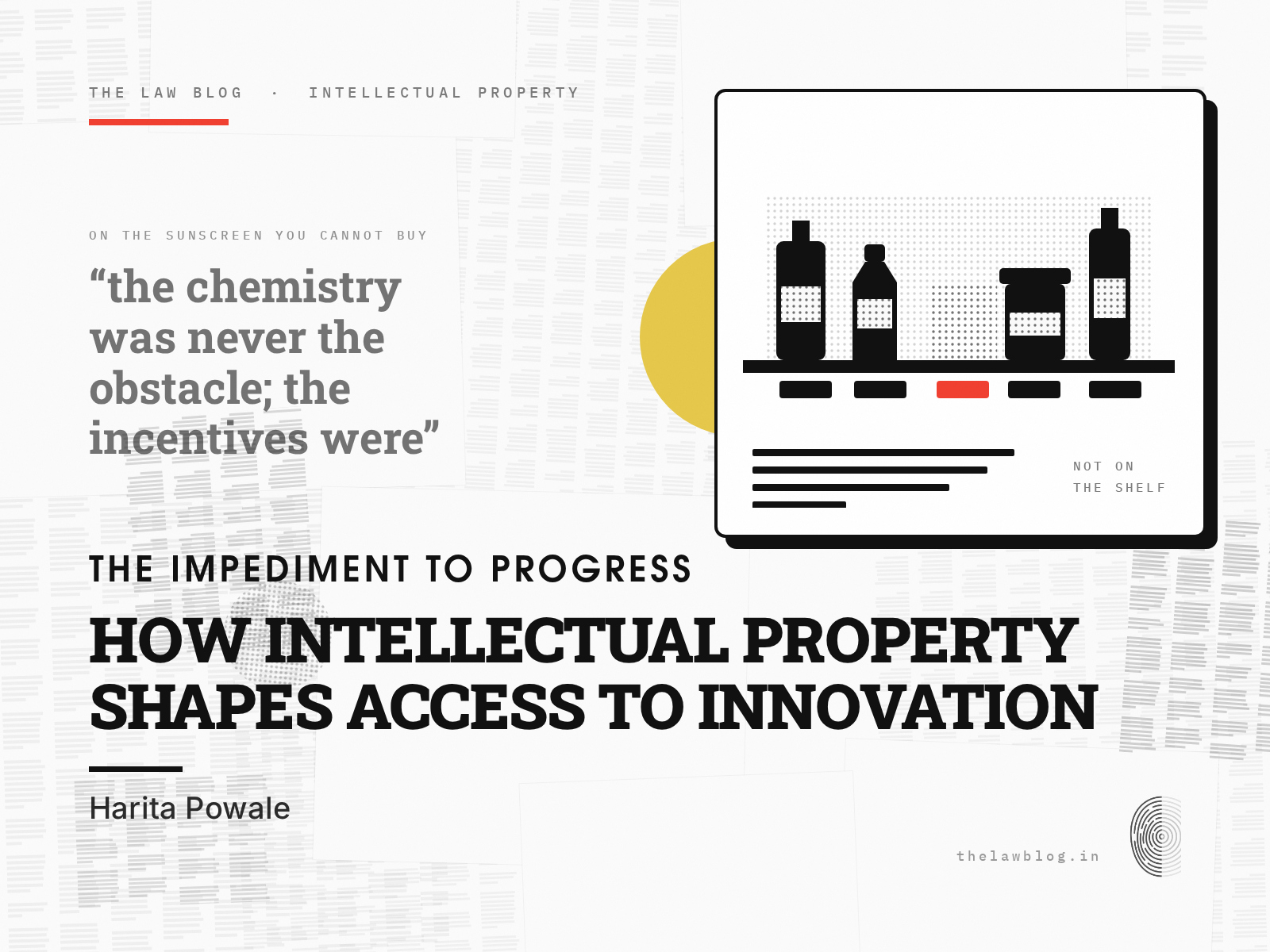
Imagine a sunscreen formulated with the world’s safest UV filters, suitable for all skin types and offering maximum protection. Chemistry exists. So does the demand. Yet why does this product not exist on shelves in many of the world’s largest markets? The answer to this question has less to do with dermatology than with a legal instrument most associated with pharmaceuticals and smartphones: patents.
This is not a hypothetical issue. Over the past two decades, better ultraviolet filters have been developed and sold in jurisdictions such as the European Union and parts of Asia. These filters offer broader UVA protection with better photostability than older alternatives. The problem lies in the years of delayed access which the consumers in other major markets face. One reason is lengthy regulatory approval. Since the patent term begins on filing, years spent awaiting approval deplete the company’s period of commercial exclusivity. Once approval is granted, the remaining patent exclusivity remains too short to justify the substantial investment made to enter the market. This results in a peculiar market failure. Innovation and demand? Exist. The incentive to introduce it has quietly disappeared. Innovation is rewarded by every economy. The real question is whether society should have to pay for that reward.
This is the paradox that lies with intellectual property law. The same framework built to reward innovation is also the reason it doesn’t reach you. To understand this paradox, we need to look beyond statutes to the economics that anchor patent law.
Incentive Drives Innovation
Ideas are unusual goods. Once created, it costs little to copy, as copying is always cheaper than inventing. A market, under this principle, would not substantially invest in research, as no system exists to forbid competitors from piggybacking on the breakthrough as soon as it’s public. Patents exist to correct this free-riding. They grant inventors a temporary monopoly, giving them a chance to make up the cost of the time spent before they succeeded.
According to Section 2(1)(j), Patents Act, 1970, a patentable invention is “a new product or process involving an inventive step and capable of industrial application”. Simply put, unveil your blueprints and the law grants temporary exclusivity. But as every bargain has two sides, what society gives up is where the debate lies.
A Reward or a Barrier?
To an economist, patents are both: a reward for creativity and a restraint on competition, depending on where you stand.
The pro-patent stance is simple. If no exclusivity exists, why would a pharmaceutical company spend vast sums over decades to develop a compound that can be replicated for a fraction of the cost by generic manufacturers? Patents transform piggybacking into an incentive for innovation.
The counter-stance is just as warranted. Patents are simply government-sanctioned monopolies, which limit output and raise prices. There are dire consequences when the product is a life-saving drug rather than a luxury item. Critics argue that breakthrough medicines come with price tags that are beyond the reach of the very public health systems that funded the research. This raises a crucial question: do patents prioritise profit over public access?
The debate, then, is rarely about whether monopolies are good or bad in the abstract. It argues about how long a monopoly should last and who bears the cost of the wait.
The Economics Behind This Bargain
Patents are economic incentives as much as legal rights. Economists distinguish between static efficiency, which focuses on affordable access today, and dynamic efficiency, which asks whether the system encourages future innovation.
Yet the economic challenge is finding a system that preserves the dynamic gains of innovation without imposing unrestrained static costs on access. An invention having excessive exclusivity contributes less to economic progress by remaining commercially inaccessible than one which is widely adopted. This points to more of an optimisation problem: how can we design a system that keeps the dynamic gains of incentivized innovation without imposing static losses on access? Each patent term, each compulsory licensing clause, each patentability threshold is an attempt to answer that question, always as a compromise rather than a solution.
But Why Intellectual Property?
Much of this discussion has been spent asking how much protection an invention deserves. But maybe there is a fundamental question that exists: why should knowledge be treated as property at all?
Intellectual property rights may appear natural today, but they are legal institutions made to pursue specific social objectives. Drahos’s ‘A Philosophy of Intellectual Property’ invites us to scrutinize those objectives rather than treating the property right itself as the starting point. If the purpose of a patent is to encourage innovation by giving the inventor a temporary exclusive right, what happens when the right begins to restrict the very innovation it was created to encourage?
Rarely is knowledge a final product. It is rather the raw material for what comes next. A discovery becomes the foundation for another discovery, and one technology becomes the starting point for another technology. Hence, where should one inventor’s end and the next investor’s opportunity begin?
Innovation Creates Wealth
The focus of the patent discussions is often whether inventors deserve exclusive rights. Yet the more fundamental question is actually economic: where does wealth actually come from? Contrary to common beliefs, countries do not become richer simply because more money is printed or more goods are exchanged.
The thing that drives long-term prosperity is productivity, which is creating greater value with the same or fewer resources. This can be best achieved by innovation. A safer sunscreen, a faster data processor or a life-saving pharmaceutical drug creates wealth not by merely being sold, but by improving health, saving time, reducing cost and enabling further innovation.
Thus, intellectual property law performs an economic function beyond protecting inventors. It aims to encourage the continuous creation of new ideas which ultimately expand the productive capacity of society.
Who Gets to Innovate?
But if innovation creates wealth, is every economy equipped with the same mechanisms and opportunity to do so?
Thomas K. Cheng’s distinction between frontier and laggard innovation gives us another way to approach this question. Some economies operate at the technological frontier, where progress is dependent upon the production of new technologies. Other economies are still catching up, where technological advancement may depend more heavily on accessing, adapting and improving technologies that already exist. This difference is what complicates the patent bargain. What if the exclusivity that encourages a breakthrough in one economy makes it harder for another one to reach the technologies that already exist?
The answer looks different from the perspective of a frontier innovator. Research is expensive. Without protection, anyone can reproduce an invention without bearing the cost of creating it. But from the perspective of an economy which is still building its technological capacity, access to existing knowledge itself is a prerequisite for innovation. If every breakthrough builds upon existing knowledge, can economies still climb when access to the layers below is restricted?
This distinction is particularly significant when viewed through the broader divide between the Global North and the Global South. Cheng’s framework does not suggest that the divide is absolute. It rather draws attention to the fact that economies may experience the same patent rule differently, entirely depending on the stage of technological development they are at. Rights protecting the returns of frontier innovators may simultaneously restrict the ability of catching-up economies to adapt or build upon that technology. However, this doesn’t entail that the interests of developing economies lie simply in weaker patent protection.
Countries seeking to develop their technological capabilities may also need to attract foreign R&D, investment and technological transfer. Stronger protection can often give foreign innovators more confidence to license technology, establish research operations or enter markets. But the very exclusivity that made its arrival possible may also determine the fate of the resulting technology. Therefore, could stronger protection help bring innovation into an economy while simultaneously making it harder to access once it arrives?
Perhaps the tension is not between innovation and access. Perhaps it is between different kinds of innovation that occur at different stages of development. The frontier economy needs incentives to create what does not exist yet, while the catching-up economy may need room to learn from what already does. If both of these are important for technological progress, can one patent system reconcile the two?
This dilemma is clearly illustrated by the sunscreen that opened this discussion. For the company developing a new UV filter, years of research can be turned into a recoverable investment by patent protection. However, for a manufacturer or researcher in a catching-up economy, the very access to that technology may be the starting point for developing something better, cheaper or more suitable for its own market. This same patent can thus look like a reward from one side and a boundary from the other.
India’s Balancing Act
India provides a particularly interesting example of how this tension is translated into law. Few jurisdictions illustrate this trade-off as clearly as India, which must simultaneously cultivate foreign R&D investment and keep medicines affordable for over a hundred crore people. India’s patent regime reflects this example clearly. Section 3(d), Patents Act, 1970 prevents patents from making minor modifications of known substances unless they showcase enhanced efficacy, preventing “evergreening”, the practice of making trivial tweaks to extend a drug’s patent life indefinitely.
In Novartis AG v. Union of India, (2013), this principle was upheld by the Supreme Court by denying patent protection for the modified cancer drug Glivec, as it failed to meet this threshold. Similarly, public access was prioritised through compulsory licensing and authorization of generic production in Natco Pharma Ltd. v. Bayer Corp., Compulsory License Application No. 1 of 2011, where the kidney-cancer drug Nexavar was originally priced beyond the reach of the public it was meant to serve.
India’s approach has been acclaimed for protecting public access to medicines but criticised for potentially discouraging pharmaceutical innovation. This balancing act extends beyond medicine to agricultural technology and even everyday consumer products. Delayed access to innovation carries a high economic cost. Consumers continue using older, less effective technologies because newer alternatives are commercially unavailable. Looking at this from a public policy lens, the objective is not only to attract research and development, but also to ensure that the innovations produced by such investment become meaningfully accessible to society.
Breaking New Ground: AI and Biotechnology
As patent debates shift from molecules to code and cells, the framework struggles to keep up. Generative AI can now produce inventions with minimal human input, which challenges patent law’s requirement of a human inventor. This is an issue highlighted in the widely debated DABUS patent applications. If an algorithm designs the molecule, who owns the monopoly? Does the incentive rationale for patents even apply to an inventor that does not need financial motivation to “invent”?
In parallel, biotechnology today enables cheaper and faster organism modifications through CRISPR-based gene editing, but creates overlapping patents that may hinder future innovations by restricting access to foundational technology. When the building blocks of biology are owned privately, every subsequent innovator must negotiate access before they can even begin.
Where This Leaves Us
Returning finally to the sunscreen, the chemistry was never the obstacle; the incentives were. Intellectual property law is a constant attempt to balance innovation and accessibility. Too little protection may discourage innovation; too much may delay society accessing its benefits. Innovation does not end when an invention is created. It only achieves its purpose when that invention can reach the people who need it.
This balance becomes even more essential for countries like India, where a large population makes the question of access particularly significant, while continued foreign R&D investment is equally important for economic and technological development. The aim should not be to choose between access and innovation, but to design incentives which allow one to reinforce the other. Perhaps the real measure of an effective intellectual property system is not simply how well it protects inventions, but how effectively it converts invention into accessible progress. The next time a breakthrough product is missing from our shelves, the question may not be, “Why hasn’t science solved this?” but rather, “Have we designed the incentives to enable science to reach us?”
Leave a Reply