
Shamitha B C is a second-year law student at SLS Nagpur, and has research interests in the area of ADR, and Corporate Law. Shreyas S Kulkarni is a final-year law student at the same institute, and has research interests in real estate regulation and litigation.
Section 28 of the Indian Contract Act, 1872 (hereinafter referred to as ‘the ICA’) legally validates the presence of an arbitration clause within an agreement, which acts as an exception to agreements in restraint of legal proceedings. Section 16(1)(a) & (b) of the Arbitration and Conciliation Act, 1996 (hereinafter referred to as ‘the A&C Act’) sever the arbitration clause within an agreement and the agreement as a whole, meaning that the mere invalidity of the contract does not invalidate the arbitration clause. The contents of the arbitration clause must have a ‘lawful object’, and what objects are lawful is mentioned in Section 10 and Section 23 of the ICA, respectively.
For any arbitration clause or agreement to be void it should satisfy any of the following conditions:
- it is not in consonance with any of the provisions of the A&C act; or
- the lawful object is forbidden by any law; or
- it is fraudulent; or
- it is opposed to public policy.
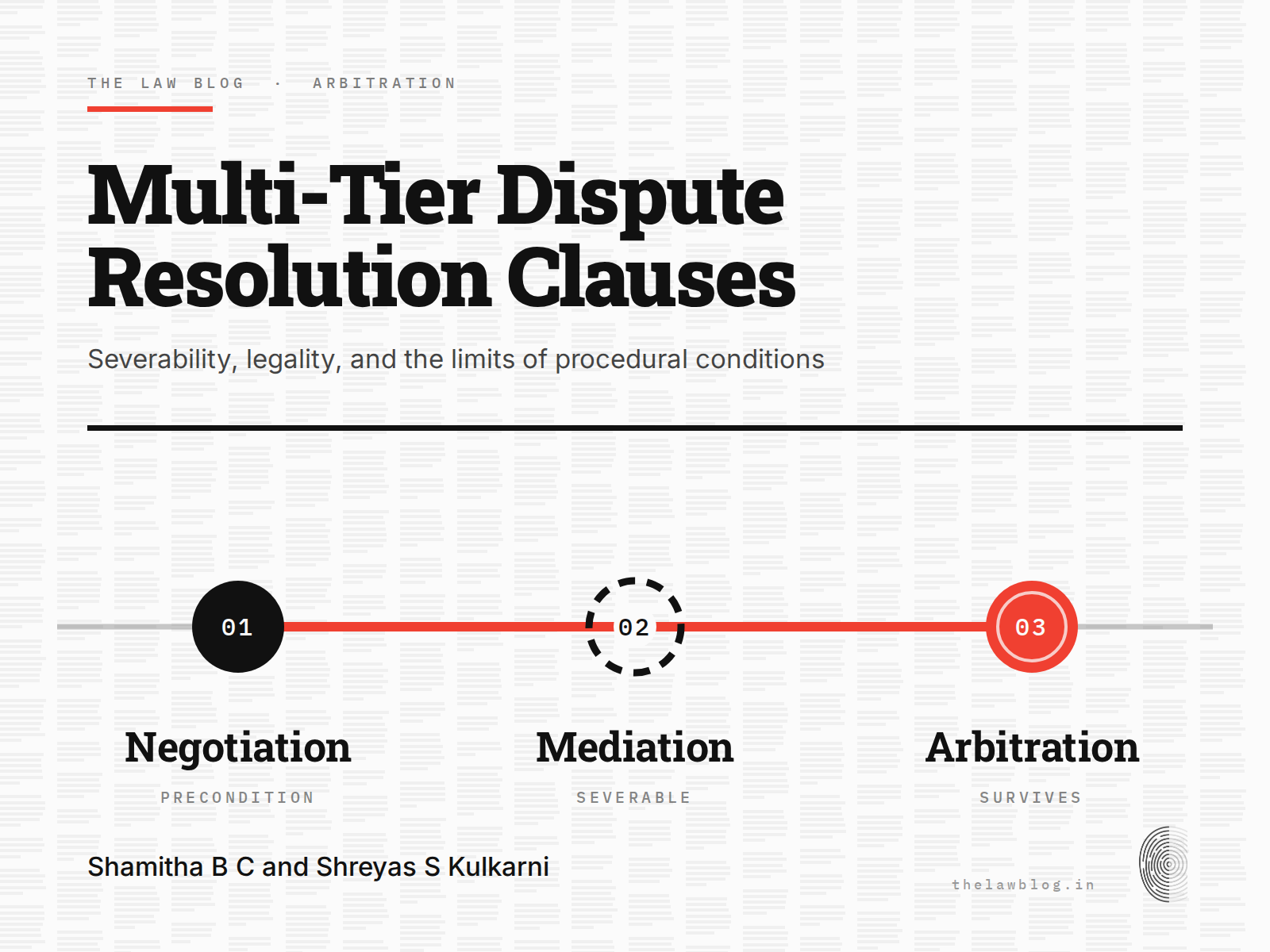
A multi-tier dispute resolution clause, also called an ‘Escalation’ or ‘Step Clause’ within an arbitration agreement, is a provision that allows the parties to proceed through certain prerequisite steps before bringing the dispute to arbitration or litigation. The standard stages of alternative dispute resolution (hereinafter referred to as ‘ADR’) in a multi-tier clause are:
- Primarily Negotiation,
- Secondary Mediation or Conciliation and
- Tertiary Arbitration.
The emphasis on the multi-tier clause has several objectives, including saving time and reducing costs.[1] It is a non-adjudicatory method of pre-arbitration dispute resolution; it preserves the parties’ relationship and reputation, maintains confidentiality, and is non-binding, allowing the parties to discuss their dispute transparently. This blog delves into the significance of understanding the severability and legality of a severed sub-clause within a multi-tier arbitration clause in an agreement.
Can a Multi-Tier Dispute Resolution Clause (MTDRC) in Itself Be Severed?
Severability works at two levels in an MTDRC. Outer severability states that the invalidity, termination, or repudiation of the main or container contract does not render the MTDRC (arbitration clause) void. In contrast, Inner severability addresses whether a defective pre-arbitral tier can be struck out while the agreement to arbitrate survives.
Section 16(1) protects an ‘arbitration clause’, and a negotiation or mediation tier is not one because it does not submit any dispute to arbitration, as Section 7 of the A&C Act requires. Inner severability therefore does not protect the tiers; it protects the arbitration agreement from them. The question whether a defect in an ancillary step should be allowed to contaminate the primary promise to arbitrate, is answered by the general law of severance with the pro-enforcement policy behind Section 16 pointing the similar way.
Before examining the concept of inner severability, it is necessary to understand the ‘Blue Pencil Rule’ (hereinafter referred to as ‘BPR’), also known as the Doctrine of Partial Severability. BPR is defined in paragraph 20 of the Shin Satellite Public Co. Ltd. v. Jain Studios Limited (2006), as a rule of construction that allows the court to enforce the legal and valid part of the contract while diligently severing (striking out) the illegal, invalid, unenforceable non-operative part of the contract without destroying the essence or substance of the contract.
The individual pre-arbitral tiers can be severed as void by applying the BPR in three scenarios: vague pre-tiers, futility and impossibility, and mandatory and directory, admissibility and jurisdiction distinctions.
Vague Pre-Tiers
When there is an agreement to settle the dispute in good faith but there is no objective or intent to settle it as per the wordings of the clause, it is often treated as an unenforceable agreement. A tier that is too vague to be enforced is void for uncertainty under Section 29 of the ICA. But severance is harder where the parties made the tier a condition of their consent to arbitrate, or where striking it out would change the bargain. Such as in the case of Sulamérica CIA Nacional de Seguros S.A. v. Enesa Engenharia (2012), the English High Court held that the mediation clause was too uncertain to be enforceable. It contained no unequivocal commitment to mediate, no defined mediation process and no mechanism for appointing a mediator. The Court of Appeal agreed. The mediation step therefore imposed no condition precedent to arbitration, and the arbitration could proceed.
Futility and Impossibility
In this scenario, pre-arbitral tiers can be directly bypassed under the doctrine of futility. If there is a breakdown of relations or urgency or the other party’s outright refusal to negotiate, it would be an empty formality to enforce the pre-arbitral tiers and cause delay. Hence, pre-arbitral tiers may be bypassed allowing the recourse of arbitration. The same applies to impossibility, if a tier cannot practically be performed, for instance because the counterparty is unreachable, it cannot stand in the way of arbitration.
In Walford v. Miles (1992), the House of Lords refused to enforce an agreement to negotiate, holding that a duty to negotiate in good faith is inconsistent with the adversarial position of negotiating parties. In contrast, Emirates Trading Agency LLC v. Prime Mineral Exports Private Ltd (2014) enforced a time-limited obligation to pursue friendly discussions as a condition precedent to arbitration, reasoning that commercial parties expect their bargains to be enforced and that avoiding costly arbitration serves the public interest.
Two theories explain this divergence. Relational contract theory, associated with Ian Macneil, treats tiers as a way of preserving a continuing business relationship, which favours enforcing them. Law and economics treat them as cooling off devices that save the cost of needless arbitration but can also be used for strategic delay, which favours enforcing them only where they have a real prospect of working. Futility is the law’s answer to that second concern.
The Supreme Court of India in the case of Demerara Distilleries (P) Ltd. v. Demerara Distillers Ltd. (2015) held that a requirement to attempt amicable settlement need not be followed where there is no scope for settlement and compliance would be an empty formality. Futility does not invalidate the tier. It only excuses its performance.
Mandatory and Directory, Admissibility and Jurisdiction Distinction
The BPR does not apply directly in this scenario. Where a valid tier is skipped, the question is no longer its validity but the consequence of non-compliance. Indian courts frame this as whether the tier is mandatory or directory, a test that grew out of referral-stage decisions under Sections 8 and 11 of the A&C Act, where the court had to decide whether to refer the parties or appoint an arbitrator. The Delhi High Court treated a pre-arbitral discussion clause as mandatory in Haldiram Manufacturing Co. (P) Ltd. v. DLF Commercial Complexes Ltd. (2012), but held it directory in Ravindra Kumar Verma v. BPTP Ltd. (2014). The court reasoned that mandatory compliance would shorten the limitation period, contrary to Section 28 of the ICA, and that Section 77 of the A&C Act allows arbitral proceedings to be started to preserve rights. Later benches have largely followed the directory view (Oasis Projects Ltd. v. NHIDCL (2023); Jhajharia Nirman Ltd. v. South Western Railways (2024)), though some treat multi-stage procedures as mandatory (BKSons Infrastructure Pvt. Ltd. v. NHIDCL (2024)). The outcome turns on the wording of each clause, with no settled criteria.
Courts in Hong Kong and England use a different vocabulary, that is of admissibility and jurisdiction. A jurisdictional defect goes to the tribunal’s power, so a court can review it afresh and set the award aside. An admissibility defect goes only to whether the claim is ready (ripe enough) to be heard. The tribunal decides it, the court does not revisit it, and the remedy is procedural, such as a stay or a finding of prematurity, rather than invalidation of the award. In the case of C v. D (2023) the Hong Kong Court held that compliance with a pre-arbitration condition was for the tribunal and could not be reopened on a set-aside application, unless the parties expressly agreed otherwise. In the case of NWA v. NVF (2021) the England Court dismissed a Section 67 challenge under the Arbitration Act 1996 for the same reason.
The two approaches are complementary. The mandatory-directory label says only whether a step must be performed. It does not say who decides non-compliance, whether the award can be challenged under Section 34, or what the remedy is. The first asks whether the tier binds, and the second asks what follows when a binding tier is skipped.
India should therefore adopt the admissibility approach for questions of compliance, while retaining the mandatory–directory inquiry for the prior question of whether a tier binds at all. This is justified on three grounds. First, Section 16 of the A&C Act empowers the tribunal to rule on its own jurisdiction, and Vidya Drolia & Others v. Durga Trading Corporation (2020) confines the referral court to a prima facie review of the arbitration agreement; whether a tier was exhausted does not go to the existence of that agreement and is therefore not a matter for the referral court. Second, treating non-compliance as jurisdictional invites a second round of litigation at the Section 34 stage, as parties would try to bring a skipped tier within Section 34 sub-section (2) clause (a) sub-clause (v), which covers arbitral procedure not in accordance with the agreement of the parties. Third, admissibility offers a curable remedy, namely a stay until the step is taken, which answers the limitation concern raised in Ravindra Kumar Verma without having to treat every tier as directory. Party autonomy also remains intact, because, as C v. D recognises, the parties can expressly agree that compliance with a tier is reviewable by a court.
Legality of the Severed MTDRC Clause
Once a defective tier is severed, whether the remaining portion is legally enforceable? The answer for the same is again in affirmative. The remainder is a plain agreement to submit disputes to arbitration, with a lawful object as per Sections 10 and 23 of the ICA, and it is supported by the parties’ continuing mutual promises, so the distinct consideration requirement of Section 24 is met. It also satisfies Section 7 of the A&C Act, and it keeps the protection of Section 16(1)(a) and (b) against any challenge to the main contract, so that outer severability operates on the clause that inner severability has left. Severance is not automatic, but where the tier is inseparable from the parties’ consent to arbitrate, the Shin Satellite test fails and the whole clause may fall.
Conclusion
The presence of MTDRC within a contractual agreement is highly beneficial objective that encourages amicable settlement, preserves business relationships, and reduces costs before resorting to litigation. When these pre-arbitral tiers are poorly drafted, they transform from cost-saving mechanisms into fertile grounds for litigation and procedural delays. The concepts of inner severability are important judicial tools for ascertaining the true intent of the contracting parties.
To prevent unintended severance of the MTDRC tiers and prolonged jurisdictional battles, legal practitioners and contracting parties must adopt a meticulous approach to contract drafting. The wording of the agreement must be clean and direct, with no grammatical confusion in order to describe the core intent of the contracting parties. Exact, unambiguous reasonable time limits for each pre-arbitral tier’s functioning must strictly be mentioned within such an agreement. Upon the expiration of the time period, the clause must explicitly state that the dispute automatically escalates to the next tier, preventing claims of prematurity.
[1] Ashu Dhiman and Param Bhamra, Mediation: Practice and Strategies in India (2023).
Leave a Reply