
Muskan Kumari is a fourth-year law student at Chanakya National Law University, Patna, with an interest in Constitutional Law, Public Policy, and Human Rights.
The Assam Mizoram border dispute is one of the most persistent and, at times, violent territorial disputes between Indian states. The July 2021 clash at Lailapur which resulted in the deaths of several police personnel, illustrates the extent to which the dispute has produced serious and sometimes fatal violence. Beneath the political question of which state has jurisdiction over the disputed forest area lies a legal question. Two historical instruments are at the centre of competing claims concerning approximately 509 square miles of reserved forest between what was once Cachar district and the Lushai Hills (now principally Mizoram). Mizoram bases its claim on a notification issued in 1875, while Assam relies on an instrument issued in 1933. The pertaining legal question is whether the 1933 instrument could alter the legal effect of the 1875 notification and, consequently, which historical instrument has greater relevance to the present boundary under the constitutional framework.
The 1875 notification and the 1933 circular
The Bengal Eastern Frontier Regulation, 1873 was enacted by the British colonial government. The Regulation was enacted under the legal framework established by the Government of India Act, 1870, which empowered the Governor General in Council to make laws and regulations concerning the frontier districts. On August 20, 1875, the Governor-General-in-Council used this authority to issue Notification No. 2299P. The notification prescribed an Inner Line along the southern boundary of the Cachar district, separating the plains from the adjoining hill areas. A fictitious border which Mizoram treats as the foundational boundary protecting Mizo customary territory, was established under the legislation, and persons from the plains were prohibited from entering the hill areas without the requisite authorisation of the colonial authorities. As per this notification, the disputed reserved forest area became the part of the present Mizoram. The Assam government refuses to accept that the 1875 notification intended to make the Inner Line as a boundary between Cachar and Lushai Hills.
Assam, anchors its claim to an administrative circular issued nearly six decades later. W.A. Cosgrave, the Chief Secretary to the Government of Assam at the time, passed the 1933 instrument through notification number 2106 A.P. On March 15, 1933, it was published in the Assam Gazette. On its terms, the circular demarcated the boundary between the Lushai Hills and the princely State of Manipur. It identified the starting point of the Manipur boundary at the tri-junction of the Lushai Hills, Cachar district of Assam and Manipur. The 1933 boundary revision placed substantial portions of the area covered by the earlier inner line reserved forest within the boundary claimed and administered by Assam, thereby producing the territorial overlap that later became the Assam–Mizoram border dispute. The boundary revision through this circular was based on the Survey of India. Assam contends that the 1933 circular superseded the 1875 notification and now forms the basis of the constitutional boundary.
The 1875 notification’s statutory foundation
A notification issued in exercise of statutory power derives its legal authority from the enabling legislation and may have the force of law within the scope of that statutory power. The Supreme Court of India made this clear in the case of F.N. Balsara, 1951 SCC 860, where it held that an order made by the government in exercise of power given by an Act owes its legal efficacy to the Act and therefore has the force of law as if made by the legislature itself. This article thus argues that the 1875 notification was not just an administrative note. It was, in legal terms, a statutory instrument, as it was issued under the Bengal Eastern Frontier Regulation, 1873.
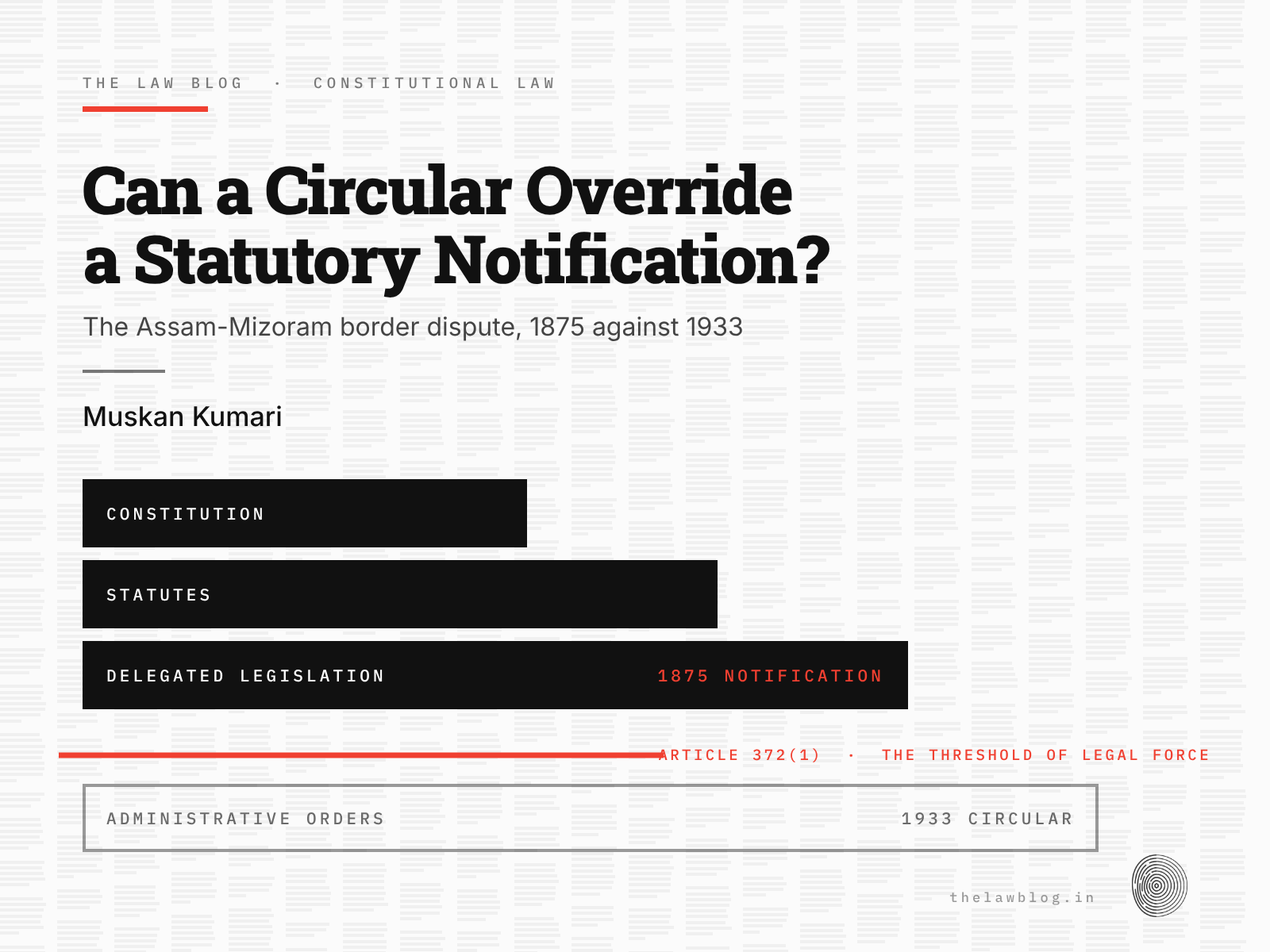
The Kelsenian hierarchy of norms (Stufenbau) and Hart’s rule of recognition explain the 1875 notification’s statutory validity. Applying Kelsen’s model in M/S. Ispat Industries Ltd v. Commissioner of Customs, Mumbai ((2006) 12 SCC 583), the Supreme Court ranked Indian law into four tiers: the Constitution, statutes, delegated legislation, and purely administrative orders. The 1875 notification was authorized by the Bengal Eastern Frontier Regulation, 1873, which was enacted under the Government of India Act, 1870. This places it on the third tier as valid delegated legislation. Conversely, Chief Secretary W.A. Cosgrave’s 1933 circular adjusted the boundary after a Survey of India exercise without any statutory backing, leaving it on the fourth tier as a mere executive instruction. Hart’s lens confirms this result as the rule of recognition ranks multiple sources of law in an order of relative superiority and inferiority so that when two rules conflict, the superior source prevails. Hence, 1875 notification being a statutory instrument would prevail over the executive orders of 1933.
Additionally, the 1875 line appears to have a stronger claim to procedural legitimacy that the 1933 circular lacks. In Old Jalukai Village Council v. Kakiho Village, 2024 SCC OnLine SC 5509, the Court held that consent of the parent village is a condition precedent for territorial changes affecting ancestral land. The Government of Mizoram, its political parties, and its civil society organisations have consistently accepted the inner line demarcation of 1875 notification as the boundary because it was issued based on an agreement between Mizo chief Suakpuilala and Captain Lister in 1850. In contrast, the Assamese government exerted pressure to accept the 1933 instrument as the starting point for negotiations. A boundary established with the participation or consent of affected communities may have a stronger procedural claim than one imposed solely through administrative action.
Assam’s Positions
The Assam government argues that the 1933 circular has gained official recognition through the North East Reorganisation Act, 1971. However, the statutory recognition of the 1933 notification does not, by itself, settle the dispute over the boundary. The dispute did not formally arise in the same manner immediately after independence in 1947. From 1952 onwards, the Lushai Hills formed a district within the state of Assam. No fresh ground demarcation was done. Instead, the North East Reorganisation Act of 1971 provided that the Mizoram Union Territory would comprise the territories that formed part of the Mizo District of Assam immediately before reorganisation. Accordingly, Assam’s principal argument is that the 1933 notification reflects the constitutional boundary line inherited at the time of state reorganization and drawn by Survey of India, so it should govern the present Assam–Mizoram border.
However, the legal significance of the 1933 notification requires closer examination. Allegedly, it was an executive decision and was not enacted under the legal framework of any statutory authority. This article argues that the 1933 circular was issued due to what colonial administrators termed administrative adjustments. Also, in Pogaru Ramamurthi v. Raja Mirja, 1932 SCC OnLine Mad 95, it was held that a survey decision does not have legal effect of terminating possession. Hence, it was an internal administrative realignment in order to facilitate easier day-to-day administration, and was not a legislative act aimed at permanently changing territorial jurisdiction.
The effect of the 1971 Reorganisation
The Supreme Court’s reasoning in Distt. Council of United Khasi and Jaintia Hills v. Sitimon Sawian, (1971) 3 SCC 708, further rejects administrative convenience as a ground for boundary demarcation. That case concerned a 1934 notification ceding certain villages for the specified purpose of municipal administration only. Even though the Shillong Municipality had, for decades, administered those villages as though full jurisdiction had passed, the Court declined to read the notification beyond its stated purpose. The Supreme Court held that a specific-purpose administrative instrument does not expand into a general jurisdictional transfer. A similar argument may be considered in relation to the 1933 Inner Line: an instrument issued for the specific, limited purpose of prescribing an administrative line does not, by itself, establish that the line became the constitutionally recognised inter State boundary simply because the 1971 Act later adopted the resulting district by reference, without independent demarcation.
Under Indian public law, statutory provisions generally prevail over executive instructions that lack statutory authority. Even though, the circular of 1933 was with official recognition by North East Reorganisation Act, 1971, the relevant question is whether that recognition transformed its legal status or merely incorporated an existing administrative boundary for the purposes of territorial reorganisation. Without following the necessary procedures, the Northeast States Reorganisation Act, 1971 recognised the 1933 redrawn inner line as the official border between Assam and the Northeast states. When the 1971 Act designated the 1933 Inner line as the official border between Assam and the Northeast states, the Act never actually changed the inner line description, didn’t consult the communities living there, or conducted any physical demarcation.
The disagreement between the states about the determining notification is actually a deeply rooted problem. Mizoram contends that Assam has encroached upon their historically and ancestrally connected territory. Mizo People’s claim over their land is not merely administrative but it also raises the questions of identity, customary land relations, and cultural continuity. Tribal communities have an inextricable and historically grounded relationship with their land. Customary law, territorial boundaries and inheritance rights were conveyed down the generations in oral tradition, a living legal and geographic record which colonial boundary-making neither recognised nor respected. Additionally, the Court in Her Majesty the Queen v. John Corbiere, Charlotte Syrette, Claire Robinson and Frank Nolan, 1999 SCC OnLine Can SC 27 held that mere administrative convenience cannot justify complete denial of constitutional rights. The 1933 delimitation disregarded ethnic homelands and split communities from their shared possessions. Hence, denial of constitutional rights such as customary land rights and livelihood is unjustified.
In the case of Old Jalukai, the Court noted that boundary disputes become sensitive where different tribes inhabit adjoining regions, making demarcation complex. Any administrative convenience the colonial authorities may have obtained by redrawing the line cannot, of itself, determine the constitutional status of the present boundary. The answer to the question must rather be sought in the legal instruments reorganising the territory along with the cultural and ancestral claims. What compounds the situation is that independent India has inherited the cartographic conventions of the colonial period, as it is, and this uncritical inheritance has continued to be a perpetual cause of conflict along the borders between Assam and the northeastern states.
Constitutional Continuity
For an instrument to qualify as “law” under Articles 366(10) and 372(1) of the Constitution, it must have the force of law and cannot be merely executive in nature. Although Article 366(10) defines “existing law” broadly, the instrument must still have legal force. Similarly, Section 3(29) of the General Clauses Act requires the instrument to have had the force of law before the Constitution came into effect. Article 372(1) provides that all laws in force in the territory of India immediately before the commencement of the Constitution shall continue in force. This means that Article 372(1) preserves laws that were already legally in force; it does not turn an executive circular into law merely because it existed before the Constitution.
In Kelsen’s hierarchy, a norm stays valid after a change in legal order only if a higher norm with the power to do so passes its validity down to it. Here, the Constitution is the ultimate rule of recognition, and Article 372(1) allows pre-constitutional laws to continue. This means Article 372(1) is the provision that passes validity on to older norms. So, the 1875 statutory notification carried its validity forward, while the 1933 administrative circular did not get past the constitutional threshold. If the 1933 executive circular were allowed to override the 1875 statutory notification, a mere administrative measure would gain a legal authority it never had before. That would defeat the very purpose of Article 372(1).
The 1875 notification, issued under statutory authority with maps and revenue records, therefore has a stronger basis for being treated as an existing law. In contrast, the 1933 circular, issued merely for internal administrative convenience without statutory backing, does not qualify as existing law. A government order issued by an administrative officer, without any statutory backing, is what courts have called a “mere administrative instruction.” As also observed in the case of Tulsiram Patel case [(1985) 3 SCC 398: 1985 SCC (L&S) 672], the executive instructions stand on a lower pedestal than rules framed under statues. Conclusively, Article 372(1) of the Constitution validates and 1875 notification as continuing law and the 1933 circular cannot be said to repeal that.
Conclusion
There have been repeated bouts of violence along the Assam-Mizoram border over the years, often over allegations of encroachment or construction, and the 2021 clash that killed several police officers and civilians was only the most serious flare-up in a long-standing pattern. The dispute is often articulated in political terms, particularly in terms of state identity, ethnic belonging and historical grievance. All those dimensions are real and meaningful. “Nevertheless, the dispute presents a separate legal question about the status and effect of the competing boundary instruments.” The 1875 notification was a statutory authority, implemented on the ground, and connected to historical understandings involving Mizo communities. It has the force of law and continues to have it under Article 372 of the Constitution. The 1933 notification was issued by a colonial official without statutory authority and without consultation.
Considering its administrative position, it is understandable that Assam is banking on the 1933 notification as the constitutional boundary. But the legal status of the competing instruments must be assessed according to their statutory basis, and later constitutional treatment. The better claim to recognition is the 1875 line on the legal analysis discussed here. But the legal question is just one part of the dispute. The contestation between Assam and Mizoram continues to show that the formal legal position and its political acceptance do not always go hand in hand. Hence any permanent solution will need not only legal clarity but also political will to transform that legal position into an accepted and practically demarcated boundary.
Leave a Reply