
Srishti Pant is a B.A. LL.B. (Hons.) student at Damodaram Sanjivayya National Law University, Visakhapatnam. Her academic and research interests lie in Intellectual Property Law, Commercial Dispute Resolution, Arbitration and Mediation. She has a keen interest in exploring the intersection of law, technology and emerging commercial practices, and has actively engaged with these areas through academic research, writing and competitions. She is particularly interested in the evolving legal frameworks governing intellectual property and alternative dispute resolution in India.
Imagine an Indian manufacturer and a Singapore buyer settle a payment dispute through mediation. They sign at midnight and shake hands. Three months later, the buyer stops paying. Now flip the facts: the Singapore buyer holds the signed settlement, and the Indian manufacturer’s only assets sit in Mumbai. The two scenarios look symmetrical. Legally, they are not, and the asymmetry says more about India’s mediation architecture than any headline about mediation-friendly reform.
Half a bridge
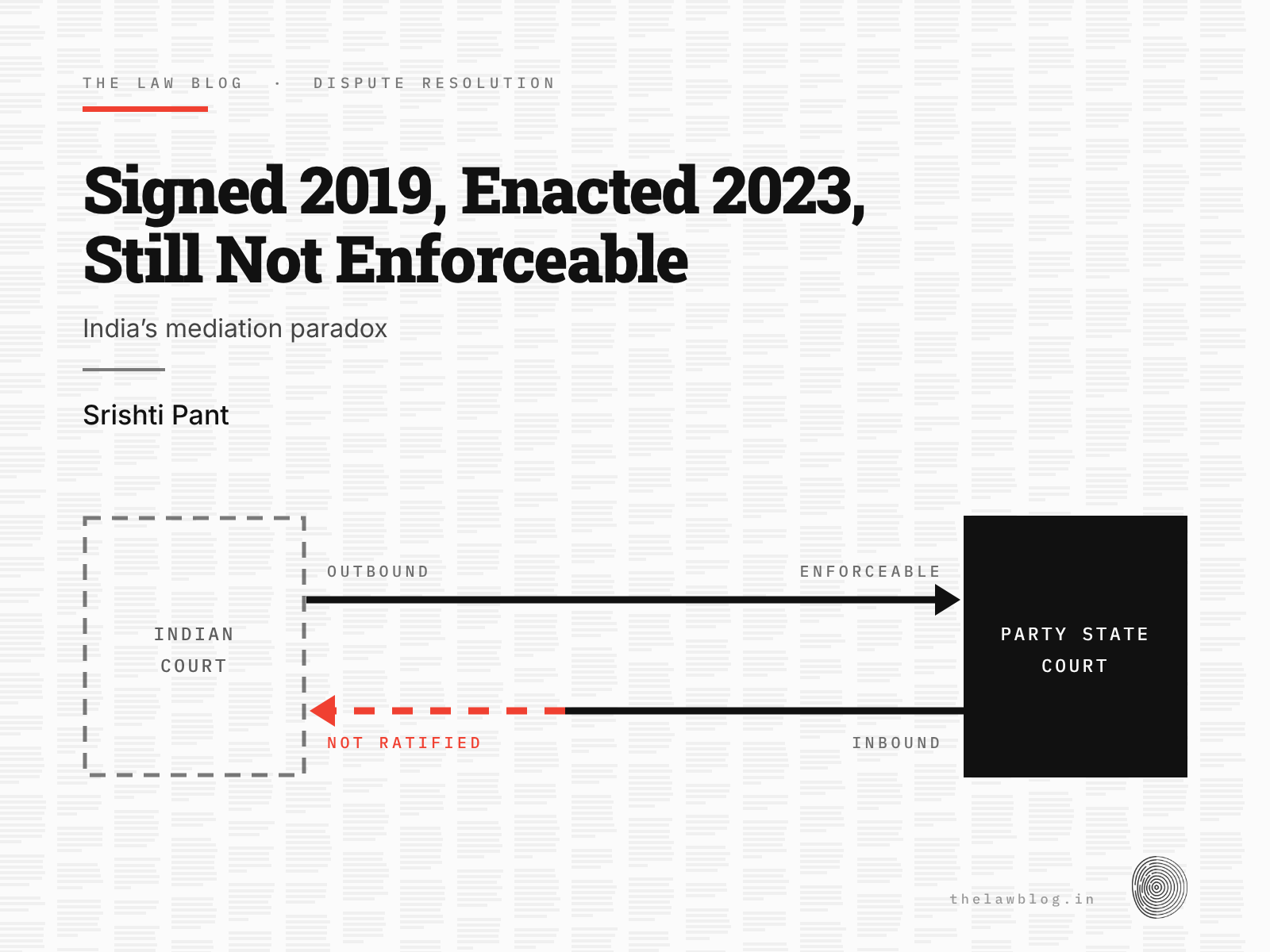
The Singapore Convention on Mediation entered into force on 12 September 2020.[1] A Party must enforce a settlement agreement “in accordance with its rules of procedure and under the conditions laid down in this Convention”, and the refusal grounds are limited.[2] Its scope turns on the parties having places of business in different States; nothing in the text requires those States to be Parties.[3] India signed on 7 August 2019 but has not ratified: the United Nations status table records a signature and no ratification.[4]
On the Convention’s text, then, the Indian manufacturer in my first scenario can take its settlement to a court in Singapore, a Party since 12 September 2020,[5] whatever India has or has not done. In the second scenario, the Singapore buyer arrives at an Indian court holding a treaty India has not made part of its law. The gap is inbound. In my view, that is what matters commercially: a foreign party decides whether to mediate with an Indian counterparty partly by asking what happens if the settlement is breached.
Even where the Convention applies, the claimant carries a documentary burden. It must produce the signed settlement and evidence that it resulted from mediation, such as the mediator’s signature or an attestation by the administering institution, and refusal grounds include a serious breach of mediator standards or an undisclosed conflict.[6] For mediation institutions, this makes the closing minutes of a mediation a matter of drafting discipline: who signs, in what capacity, and what the institution can certify afterwards.
An Act that stops at the border
The Mediation Act 2023 was meant to help, but it is inward-facing. Section 3(g) defines “international mediation” as mediation undertaken under the Act that relates to a commercial dispute in which at least one party is foreign.[7] The Act applies to mediation conducted in India, although parties may agree to hold a mediation abroad or online, in which case it is deemed to be within the jurisdiction of the competent Indian court for enforcement, challenge and registration.[8] What the Act does not do is give effect to a settlement from a mediation conducted outside it,[9] and its text does not refer to the Singapore Convention at all.[10]
The Act has also been commenced only in part. A notification of 9 October 2023 brought into force ss 1, 3, 26, 31–38, 45–47, 50–54 and 56–57,[11] so the provisions on application (s 2) and enforcement (ss 27–28) were not among them. The Mediation Council of India was established only on 27 August 2026.[12] I have found no notification commencing ss 2 or 27–28, and recent commentary says that the pre-litigation, time-limit and enforcement provisions remain unnotified. When s 27 does take effect, a mediated settlement signed by the parties and authenticated by the mediator will be enforceable under the Code of Civil Procedure as if it were a judgment or decree, open to challenge only for fraud, corruption, impersonation or a dispute unfit for mediation.[13] Until then, the same commentary treats a private mediated settlement as enforceable only as a contract.Three years after assent, the enforcement promise sits on the statute book rather than in the courtroom. Readers should check the latest Gazette before relying on this.
The arbitration lawyer’s workaround
There is a route, and it is revealing. The Convention does not apply to settlements that are “recorded and are enforceable as an arbitral award”.[14] Under section 30 of the Arbitration and Conciliation Act 1996, if parties settle during arbitral proceedings, the tribunal may, if requested, record the settlement as an award on agreed terms, which has “the same status and effect as any other arbitral award on the substance of the dispute”.[15] In my view, such an award can then be taken to courts in New York Convention States, subject to the usual defences. Today, the most dependable way to give a cross-border mediated settlement teeth is to wrap it in an arbitration: the older treaty doing the younger treaty’s work. The limit is plain. Section 30 speaks of the tribunal recording the settlement, so a tribunal must be in place; a standalone mediation with no arbitration behind it has no such route.
The contrast with domestic practice is sharper still. In Patil Automation, the Supreme Court declared s 12A of the Commercial Courts Act 2015 mandatory, so that a commercial suit instituted in violation of it must be met with rejection of the plaint under Order VII Rule 11 of the Code of Civil Procedure, with effect from 20 August 2022.[16] Section 12A applies only to suits that do not contemplate urgent interim relief, so the mandate has limits, but the policy direction is unmistakable.[17] India compels commercial plaintiffs to mediate at home while hesitating over the instrument that lets mediation travel.
What closing the gap would take
The momentum is external. As accessed, the United Nations status table lists 25 Parties, among them Oman (acceded 10 March 2026), Mauritius (ratified 17 August 2026), Uzbekistan (acceded 28 August 2026) and the United Arab Emirates (acceded 8 October 2026), the last three not yet in force for those States.[18] Three steps follow, offered as my view. First, ratify, with implementing legislation: Article 253 of the Constitution empowers Parliament to legislate to implement treaties.[19] Second, decide openly whether to make the art 8(1)(a) declaration for governmental parties, as several Parties have done, instead of drifting into the question by default.[20] The Act itself treats government parties specially, requiring prior written consent of the competent authority before a settlement is signed.[21] Third, commence ss 2 and 27–28 and revisit the “undertaken under this Act” limb of s 3(g), so that the Act and the Convention are designed to meet.
Meanwhile, practitioners need not wait. A contract that pairs a mediation step with an arbitration clause keeps the s 30 route open once a tribunal is constituted. The settlement should be drafted with the art 4 evidence in mind. And before choosing a seat or a venue for mediation, it is worth asking where the counter party’s assets are, whether that State is a Party, and whether it has made a reservation. Sceptics will say that ratification before India has trained mediators and a working Council will send untested art 5 applications to courts unready for them. That is a case for sequencing, not for waiting. Until the sequence starts, the answer to “who can enforce a mediated settlement?” will depend on whose assets are where.
[1]United Nations Convention on International Settlement Agreements Resulting from Mediation (adopted 20 December 2018, entered into force 12 September 2020) 3360 UNTS I-56376.
[3]Convention (n 1) art 1(1)(a).
[4] UNCITRAL, ‘United Nations Convention on International Settlement Agreements Resulting from Mediation’ https://uncitral.un.org/en/texts/mediation/conventions/international_settlement_agreements accessed 17 October 2026.
[5]Status (n 4) (Singapore: ratified 25 February 2020; entered into force 12 September 2020).
[6]Convention (n 1) arts 4(1), 5(1)(e)–(f).
[7]Mediation Act 2023 (Act 32 of 2023) s 3(g).
[8]Mediation Act 2023 (n 7) ss 2(iii), 13 (proviso and Explanation).
[9] Nishith Desai Associates, ‘Decoding the Mediation Act, 2023’ (Dispute Resolution Hotline, 4 September 2023) https://www.nishithdesai.com/research-and-articles/hotline/dispute-resolution-hotline/decoding-the-mediation-act-2023-10748 accessed 17 October 2026.
[11]Notification S.O. 4384(E) (Ministry of Law and Justice, 9 October 2023), Gazette of India, Extraordinary, Part II, s 3(ii).
[12]Ministry of Law and Justice, ‘Notification S.O. 4781(E)’ (27 August 2026), Gazette of India, Extraordinary, Part II, s 3(ii).
[13]Mediation Act 2023 (n 7) ss 19(1), 27(2), 28(2).
[14]Convention (n 1) art 1(3)(b).
[15]Arbitration and Conciliation Act 1996, s 30(2), (4).
[16]Patil Automation (P) Ltd v Rakheja Engineers (P) Ltd (2022) 10 SCC 1, [92].
[17]Commercial Courts Act 2015, s 12A(1); Mediation Act 2023 (n 7), sch 9.
[18]Status (n 4) (Parties: 25).
[19]Constitution of India 1950, art 253.
[20]Convention (n 1) art 8(1)(a); Status (n 4), notes (b) and (c).
Leave a Reply