
Jai Prakash Shukla is a second-year law student enrolled in the B.A. LL.B. programme at Dharmashastra National Law University, Jabalpur, with a keen interest in legal research and writing.
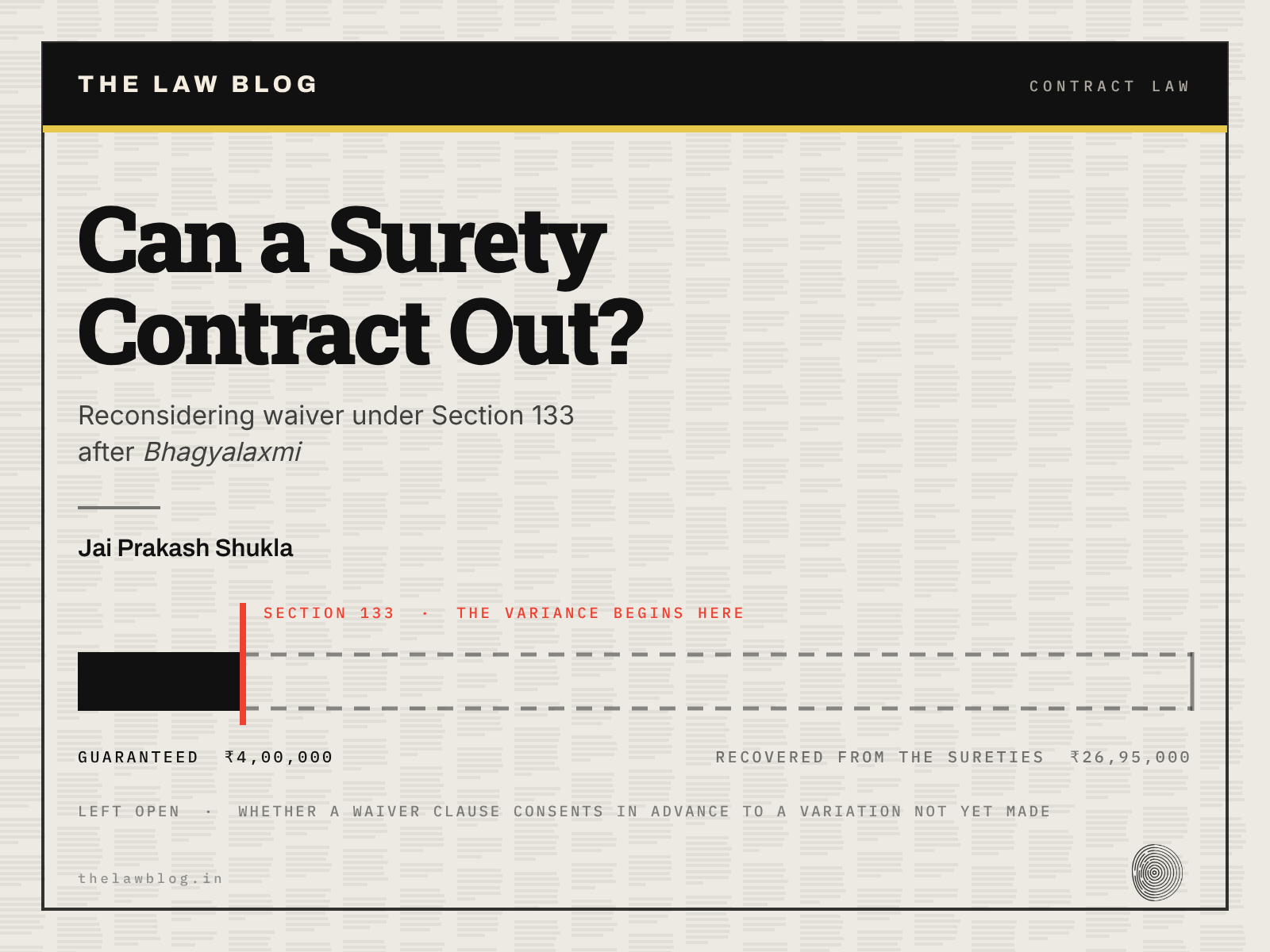
In the case of Bhagyalaxmi Co-operative Bank Ltd. v. Babaldas Amtharam Patel (2026 INSC 205), the Supreme Court considered the case of two sureties who made a guaranty on behalf of Darshak Trading Company for a cash-credit of ₹4 lakh. However, the borrower made withdrawals of much higher amount, and the Bank recovered ₹26.95 lakh from sureties. The Supreme Court ruled that the liability of the sureties extends only to the amount of ₹4 lakh along with interest, but the extra withdrawal amount cannot be collected from them because it is considered a variance according to Section 133 of the Indian Contract Act, 1872.
In this case, the scope of discharge in light of the variance becomes clear. On the other hand, one can question if a general clause of waiver contained in the contract with a guarantee means that any alteration could be made in the future and be considered as an advance permission to do so. In my opinion, such a broad clause of “waiver of all rights” must be understood in light of the whole guarantee contract and real consent expressed by the sureties.
Consent under the Contract Act
Sections 126 and 128 of the Indian Contract Act of 1872 have defined what a guarantee is and provided that the liability of the surety is co-extensive with that of the principal debtor unless the terms of the contract say otherwise. In Section 133, a variance without the consent of the surety will discharge the surety for the transactions after the variance. Section 13 defines consent as an agreement upon the same thing in the same sense.
In Section 128, the parties may define the extent of the liability of the surety. This does not mean that in the event there was a general agreement by the surety for future changes, he has consented to a certain variation. The main issue is whether the surety has consented to the type of variation made.
What Bhagyalaxmi decided and what it left open
The Supreme Court ruled that the sureties had undertaken to be sureties for the sanctioned facility of ₹4 lakh. Permitting the borrower to overdraw beyond this limit was a substantial variation from the agreement. Discharge under Section 133 was not total; it was only available for transactions made after the unauthorized variation. As a result, the sureties were discharged for ₹4 lakh plus interest, but not for the excess amount. Section 139 was ruled out since, although the Bank’s actions had affected the rights of the sureties, their right of recovery from the principal debtor had not been affected (paras 7–7.3).
Two observations in the judgment need to be reconciled. According to paragraph 4.6, a clause waiving “all” legal, equitable or statutory rights will not disqualify the surety from discharge under Section 133. It also places the onus of proving consent on the enforcing party. On the other hand, in paragraph 4.7, citing H.R. Basavaraj (Dead) by LRs v. Canara Bank[1], it is stated that sureties can waive their rights under Chapter VIII, provided that such waivers are for the private benefit of the surety and are not against public policy.
These observations are not the final decision on a particular variation clause. There was no waiver clause in the guarantees of Bhagyalaxmi case. As such, the Supreme Court did not make any decision on whether an advance-consent clause to particular variations could satisfy Section 133.
Limits of waiver
As summarised in Bhagyalaxmi, Basavaraj concerned a continuing guarantee covering future transactions unless revoked in writing. The Supreme Court upheld liability in light of the terms of that particular guarantee. It supports the proposition that a surety may waive rights conferred for private benefit; it does not establish that every general waiver covers every later alteration.
Section 23 of the Contract Act renders unlawful agreements void where their object or consideration is opposed to public policy. In Central Inland Water Transport Corporation Ltd. v. Brojo Nath Ganguly[2], the Supreme Court held that an unfair and unreasonable term in a standard-form contract may be unenforceable where parties have unequal bargaining power. That case concerned employment contracts, not guarantees, but its ruling on the free consent must be take into consideration. Its application to guarantees must therefore be cautious and fact-specific; it does not invalidate every bank-drafted clause.
A useful, non-binding comparison is Triodos Bank NV v. Dobbs [2005] EWCA Civ 630. The English Court of Appeal considered whether a guarantee permitting variations without reference to the guarantor extended to a substantially enlarged lending facility. The decision illustrates that advance consent to variation need not be unlimited: the change must remain within the scope of the guarantee. English law is persuasive only and cannot displace Section 133.
A workable approach
A financier with a reliance upon advance consent will need to satisfy himself on three elements. Firstly, the wording needs to outline the classes of variation which are accepted; a general waiver of all rights is not necessarily going to be taken as consent for some unknown variation that is material. Secondly, the variation needs to stay within the scope of the original guarantee. A clause for rescheduling or for time extension will not imply an expansion of the exposure guaranteed. Lastly, the financier must prove consent, as per Bhagyalaxmi (para 4.6). The answer here will need to be a contextual one. The negotiated guarantee of a director who understands business might lead to an expanded meaning of the agreed-upon risk, rather than a non-negotiated standard document from an individual surety.
Conclusion
It is clear from the case of Bhagyalaxmi that section 133 exempts the surety from any liability on accounts resulting from the alteration which is done without obtaining his/her consent, but still he/she is liable for the obligations on account of the transaction that were guaranteed by him. The provision cannot conclusively establish that whether the clause of advance waiver shall be upheld or not. Reading both paragraphs 4.6 and 4.7 together would indicate that there is a difference between the relinquishing of all statutory rights and an agreement in specific variations. It needs to be proved that this variation was within the risk known to the surety.
[1] H.B. Basavaraj (Dead) by LRs. v. Canara Bank, MANU/SC/1785/2009 (India Oct. 28, 2009)
[2] Central Inland Water Transport Corp. Ltd. v. Brojo Nath Ganguly, MANU/SC/0439/1986 (India Apr. 6, 1986)
Leave a Reply